 From the Gate
A Morning Packet's Five Plants, Checked Against the Ages in Their Trials
Liposomal Brain Complex is a five-milliliter packet of almond-and-coconut paste from San Diego. I set its five plants out like fence posts, each one beside the ages of the people who tested it.

This is a paid advertisement. Sponsored by Cymbiotika, LLC.

Carl Hensley is the name this desk signs with, and the fence line in this story is a composite, drawn from the mornings of several readers who wrote to us.
Nothing on this page credits anyone in it with a result, and what it says about the product comes from the seller's own listing, its printed panel and its posted policies, all read in September 2026.
I walk the same fence line most mornings.
It runs a little under a mile, from the gate by the road to the corner where the creek cuts under the wire.
You probably have your own version of that walk.
Maybe it's a dog, a garden row, or a lap around the block before the paper comes.
Mine starts with coffee in a steel cup and ends at the same cedar post by the creek.
Somewhere in the middle I usually run into my neighbor, leaning on his side of the wire.
We've talked across that fence for twenty-some years.
Weather, cattle prices, whose grandkid is doing what, and whose truck is making the noise this week.
Last spring he asked about a man we both used to buy hay from.
I could see the man's face, his red cap, even the way he counted bills with his thumb.
His name, though, stayed at the far end of the field.
It came back to me around noon, halfway through a sandwich, when it was no use to anybody.
Does that happen to you?
If you're reading this page, I'd guess it does, at least once in a while.
It isn't a crisis. It's a name that comes back at lunch instead of at the fence.
This page is about one small thing people have started putting into their mornings for moments like that.
It's a packet of sweet paste from a company in San Diego, and it prints five plant ingredients on its box.
But I'm not going to start with the box.
I'm going to start with a question I've learned to ask about any study anybody quotes at me.
How old were the people in it?
It sounds like a small question, and it turns out to settle a lot.
A result from twenty-five-year-olds on night shifts tells you about twenty-five-year-olds on night shifts.
A result from people in their late fifties and sixties is a lot closer to the man reading this over his coffee.
So I did with this packet what I do when I set a new stretch of fence: I measured every post from where I'm standing.
Five plants, five posts.
For each one I wrote down how much is in the packet, how much the study used, how long it ran, and how old the people were.
Some of those posts line up nicely.
Some are a long way off, and a couple sit in a different pasture altogether.
I'll show you all five, in plain words, with the numbers side by side.
Then you can decide for yourself whether it belongs anywhere near your cup.
The Name That Stays at the Far End of the Field
Let's start with you, not with the box.
Because the thing most of us notice isn't a big event, and it isn't anything to lie awake over.
It's small, everyday, and a little annoying.
You walk into the machine shed and stand there, trying to remember what you came in for.

You read the same paragraph of the farm paper twice, because the first time your mind was on the gate latch.
A word you use every week sits on the tip of your tongue while the conversation moves on without it.
Is that normal?
For most people our age it's part of ordinary life, and it usually comes and goes with a short night, a busy week or a head full of chores.
Is it something to panic about?
No, and this page won't try to make you feel that way.
If something about your memory truly worries you, the right person to talk to is your own clinician, not a website.
That's true no matter what anybody is selling, including the packet on this page.
What I'm writing about is the ordinary stuff.
The name at the fence, the reason you walked into the shed, the phone number you used to know by heart.
Most of us already have a few habits we lean on for that.
And most of us have wondered, at some point, whether there's anything more worth adding.
That's the question this page takes seriously.
Not with a promise, but with a tape measure.
A tape measure doesn't flatter anybody. That's why I trust it.
One more thing before we go on.
I'm not going to tell you that something "changed my life," because nothing in a packet has ever done that for me.
What I can do is line up the facts in a way you can check.
If a number looks wrong to you, the studies are listed at the bottom of the page, and you can look each one up yourself.
What Most of Us Already Do, and Why It's Hard to Tell What It Does
Here's what I heard from the readers who wrote in, and it matches what I do myself.
Coffee in the morning, a crossword or the word jumble, a walk, and trying to get to bed at a decent hour.
All of that is good.
None of it is anything I'd tell you to stop.
So why isn't that the end of the story?
Because with most of it, you can't really tell what it's doing for you on any given day.
You do the crossword, and some days the answers come fast and some days they don't.
You take the walk, and you feel better, but you'd be hard put to say your memory was sharper at the hardware store afterward.

There are a few habits where the research is at least pointed in a sensible direction.
Water is one of them, and it's easy to forget when you're outside and busy.
In a group of 1,111 adults aged 60 to 89 in Berlin, the third of them who were measurably low on water did worse over time on a test of processing speed. [1]
That was an observational study, so it shows a link and not a cause, but a glass of water costs very little.
A review of 18 studies of adults over 60 came to a similar, careful conclusion. [2]
There was some evidence tying low water to weaker thinking scores, and the authors said it was thin.
The plate is another one.
In a Brazilian group of 10,775 adults followed for about eight years, people eating more ultraprocessed food saw their thinking scores drop faster than those eating the least. [3]
And here's the surprise that keeps me honest.
In a three-year trial of 604 older adults, the group on a carefully planned brain-friendly diet did no better than a comparison group that simply got diet advice and cut a few calories. [4]
Both groups improved, and they improved about the same.
So a good plate helps, and the exact recipe may matter less than getting started.

So where does a supplement come in?
For most people, it comes in after those things, not instead of them.
If you're drinking water, eating a decent plate, moving every day and sleeping reasonably well, you've already done the heavy lifting.
Anything in a packet would be a small addition on top, and it's fair to ask whether it's worth the money.
That's the frame I used for everything that follows.
Not "does this replace my habits," but "is this a reasonable extra, and how close are its studies to a man like me?"
Three Kinds of Forgetting, and What Each One Asks For
Before we measure anything, it helps to notice that "forgetting" isn't one thing.
When readers described their slips to us, they fell into three plain kinds.
The first kind is the name.
You know the person, you know the story, and the one word you need won't come to the front.
That one is the most common, and it's the one people worry about most.
It's also the one that usually comes back on its own, at lunch or in the truck on the way home.
A habit older than any of us helps a little: say the name back when you first hear it.
"Good to meet you, Earl," out loud, gives the name a second trip through your head.
The second kind is the errand.
You walk into the shed, the pantry or the garage, and whatever you came for has gone back out the door without you.
That one is usually about attention, not memory.
Your head was on the last thing, or the next thing, and the reason for the trip never really got written down.
The answer to that is a list in the shirt pocket, and it's not an admission of anything.
Every good foreman I ever worked for carried one.

The third kind is the reread paragraph.
You get to the bottom of a page and realize you have no idea what the top of it said.
That one tracks closely with how rested you are and how many things are pulling at you.
A short night or a noisy kitchen will do it to anybody, at any age.
The name, the errand and the reread page. Three different slips, three different helps.
Why sort them out at all?
Because a supplement label talks about "memory" and "focus" as if they were one thing, and the studies don't.
Some of the studies we'll walk through measured recall of word lists, which is closest to the first kind.
Others measured switching between tasks or holding attention, which is closer to the second and third.
So when we get to each post, I'll tell you not only how old the people were, but also what kind of slip the study actually looked at.
That way you can match it to the kind that bothers you.
If your trouble is mostly errands, a pocket list may do more than anything in a packet.
If it's mostly names, you'll want to pay closest attention to the studies that tested word recall.
Why I Started Asking How Old the People in a Study Were
When you set a new run of fence, you don't eyeball the posts.
You measure from the last good post, every time, or the whole line wanders.
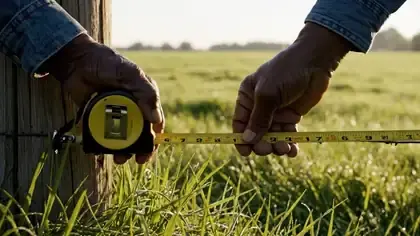
I learned the same lesson with studies, the hard way.
Years ago I bought a bottle of something because a study "showed it worked," and only later found out the study was done in college students.
Nothing wrong with college students.
But a twenty-year-old's memory and a sixty-eight-year-old's memory are different fields, and the fence doesn't run straight from one to the other.
What else do you measure, besides age?
Three things, and they're all simple.
- How much of the ingredient the study used, compared with how much is in the packet.
- How long the study ran, compared with how long you'd reasonably take it.
- Whether the people were healthy adults living ordinary lives, like most of us.
- And the age, which I put first because it's the one people skip.
Those four numbers are the posts.
If they line up with the packet and with you, you have something worth looking at.
If they're far apart, it doesn't mean the ingredient does nothing.
It means the study doesn't tell you much about your own mornings, and you should know that before you spend the money.
That's the whole method, and you can use it on any bottle or box in any store.
I'll add one more thing I always look at, because it's only fair.
Who paid for the study, when the summary says so.
A company paying for a trial of its own ingredient isn't a scandal.
Somebody has to pay, and most supplement companies never run a trial at all.
But it's something you'd want to know, the same way you'd want to know who owned the auction barn before you bought the heifer.
So where the summary tells me, I'll tell you.
Where do you find the ages in a study?
It's easier than people think, and you don't need a library card.
Every published study has a short summary at the top, usually a single paragraph.
Somewhere in the first few lines it says who was studied: "healthy adults aged 50 to 69," or "adults over 55," or "an average age of 74."
If the summary says "university volunteers" or "young adults," you already know the answer.
If it says "healthy older adults," you're in the right pasture.
What does "placebo-controlled" mean?
It means one group got the real thing and another got a look-alike with nothing in it, so the difference between them can be measured.
And "crossover"?
It means the same people tried both, one after the other, without knowing which was which.
What about "double-blind"?
Neither the people taking it nor the people measuring them knew who had the real thing until the end.
Those three words are good signs in a study.
They don't make a study big, and they don't make it about you, but they make it fairer.
What's a bad sign?
A study with no ages, no dose, or no comparison group, or a number quoted with no study behind it at all.
Ages, dose, length and a fair comparison. With those four, a study is a post you can measure from.
A Box on the Neighbor's Kitchen Counter
The packet on this page came into my life the ordinary way.
I was at my neighbor's house helping move a chest freezer, and there was a small box on his kitchen counter by the coffee maker.

His wife had bought it after seeing it on her phone.
He'd been taking a packet most mornings, stirred into his coffee, and he said he liked the taste better than he'd expected.
That's all he said about it, and I didn't ask him for more.
One man's month at the coffee maker isn't a study, and I wouldn't quote it as one.
But I did turn the box over.
And the first thing I noticed was that the back of it gave me real numbers, in milligrams, for each of its five plants.
Why does that matter?
Because a lot of boxes on the shelf don't, and without the numbers there's nothing to measure.
I took a picture of the panel with my phone.
That evening I sat down with it, a legal pad, and the summaries of the studies behind each ingredient.
It took me the better part of three evenings.
What follows is what I found, set out in the order I'd walk it.
What was on the legal pad?
Five lines down the left side, one for each plant on the panel.
Across the top, four columns: age, amount, length, and what kind of slip the study measured.
And a fifth column I added on the second evening: who paid, if the summary said.
Some boxes filled in quickly.
Others stayed empty, and I've left them empty on this page rather than guess.
That's the part I'd ask you to hold me to.
Where I don't know something, I'll say so, even when a guess would read better.
Five plants, four numbers each, and one tape measure.
Before we get to the posts, let me show you the box itself.
That way you'll know exactly what we're measuring.
What the Box Says, in Plain Words
The product is called Liposomal Brain Complex.
It's made for Cymbiotika, LLC, a company in San Diego, California, and sold on the company's own website.
Each packet holds five milliliters, which is about a teaspoon.
Inside is a thick, sweet paste made with almond butter and coconut nectar, flavored with cocoa, vanilla, cinnamon, ginger, clove and cardamom.
The label says to squeeze the packet into your mouth or stir it into your favorite drink, once a day.
The seller's own note says it's good in the morning, and that's how my neighbor takes it.
What are the five lines on the panel?
Here they are, exactly as printed, per packet.
- Rhodiola rosea root extract, 100 milligrams.
- Phosphatidylcholine, from sunflower lecithin, 60 milligrams.
- Bacopa monnieri whole-plant extract, 50 milligrams.
- Sceletium tortuosum, known as kanna, a branded extract called Zembrin, 25 milligrams.
- Huperzine A, from a club moss called Huperzia serrata, 50 micrograms.
The panel also lists 20 calories per packet and under a gram of added sugar.
In bold, it says the paste contains almond and coconut, which matters if either one is a problem for you.
What does "liposomal" mean here?
It's the seller's word for how the paste is made, with the ingredients carried in tiny droplets of fat.
The seller doesn't point to a study showing that this makes any difference to how much you absorb.
So I'll read it the way I'd read "farm fresh" on a carton of eggs: a description from the seller, not a measurement.
What does the seller say it's for?
The listing says it encourages focus and promotes learning and memory, with the standard note that the FDA hasn't evaluated those statements.
The listing makes a few broader claims too.
This page leaves those out, because I couldn't find anything in the studies that would let me repeat them fairly.
It also calls the kanna dose "clinically" something.
I'd rather tell you what the trial actually was, and I will, in the next section.

Now, the part I actually sat down to do.
Let's walk the fence, one post at a time.
Post One: Kanna, 25 Milligrams, Tested in Adults Close to Fifty-Five
I'm starting with kanna because it's the one the seller leads with, and because it's the post that lines up best.
Kanna is a low, fleshy succulent from the dry country of South Africa, where people have chewed and brewed it for a very long time.

The packet uses a branded, standardized extract of it called Zembrin, at 25 milligrams.
And there's one published trial of that extract on thinking, which is the one I'll describe.
How old were the people?
Twenty-one healthy adults, with an average age just under fifty-five. [5]
That's the closest match to a reader of this page of any study behind this packet.
Not a perfect match, since many of you are well past fifty-five, but it's the same neighborhood.
How much did they take?
Twenty-five milligrams a day, which is exactly what the packet prints.
How long did it run?
Three weeks on the extract and three weeks on a placebo, in a crossover design where every person tried both, in an order nobody knew.
What did it find?
On a computer test battery, the extract was associated with better scores on two measures: switching between tasks, and planning and organizing, which the researchers call executive function.
It was also well tolerated in that group.
That's the whole finding, and it's a real one.
Who paid for it?
Some of the authors were connected to the company that makes the extract, which is common in this field and worth knowing.
So here's how this post measures.
- Age: close, an average just under fifty-five.
- Amount: exact, 25 milligrams in the study and 25 in the packet.
- Length: short, three weeks.
- Size: small, twenty-one people.
Is that enough to go on?
It's enough to call the dose sensible, and not enough to call anything settled.
Twenty-one people for three weeks is a start, not a verdict.
Nobody has repeated it in a bigger group, and nobody has tested it for months.
One more thing you should know about kanna.
It's a plant that acts gently on the brain's own chemistry, which is part of why people have used it for so long.
If you take anything daily, show the box to your pharmacist before the first packet.
That's a two-minute conversation at the counter, and it's the right one to have.
First post: the right age, the right dose, a short run. The best-set post on this line.
Post Two: Bacopa, 50 Milligrams, Where the Trials Used 300
Bacopa is a small creeping plant that grows in wet ground and shallow water across India and much of the warm world.
It has a long history there, and it's one of the better-studied plants on any memory label.

How old were the people?
Here's the good news: the best bacopa trials were done in people our age.
One trial took 54 healthy adults aged 65 and older, and 48 of them finished. [6]
Another took 98 healthy adults over 55, and 81 of them finished. [7]
Those are exactly the fields most of you are standing in.
So on age alone, this post is set right.
How much did they take?
Three hundred milligrams a day of a standardized extract, in both trials.
How much is in the packet?
Fifty milligrams, which is one-sixth of what those trials used.
How long did they run?
Twelve weeks each, which is about three months of daily use.
What did they find?
In the older group, bacopa was associated with better delayed word recall and better scores on a test of ignoring distractions, with no difference on several other measures. [6]
In the over-55 group, it was associated with better learning and recall of word lists, and other measures didn't differ from placebo. [7]
That second trial also reported more stomach upset in the bacopa group, which is worth knowing.
A 2014 review pooled nine bacopa trials that each ran at least twelve weeks, with 518 people in all. [8]
It found faster scores on two tests of attention speed, and the authors called for a large, well-run trial to settle the question.
So here's how this post measures.
- Age: well matched, over 55 and over 65.
- Amount: a sixth of the studied dose.
- Length: the trials ran twelve weeks.
- Results: modest, on some measures and not others.
What does that mean for the packet?
It means the studies are about people like you, at a much bigger dose than this packet carries.
I can't tell you what a sixth of the dose does, because nobody has tested a sixth of the dose.
And I won't guess.
What I can tell you is that bacopa is a slow plant in the studies.
None of the trials looked for anything in the first week or two.
Second post: the right age, a sixth of the dose. Straight in one direction, short in the other.
Post Three: Rhodiola, 100 Milligrams, Tested in Young Clinicians on Night Duty
Rhodiola is a hardy plant with yellow flowers that grows on cold, rocky slopes in the far north and in high mountains.
Its thick root has been used for a long time in Scandinavia and Russia.

How old were the people?
This is where the fence line jumps a creek.
The best-known rhodiola study I could check took 56 healthy young clinicians working night shifts in a hospital. [9]
Young, healthy and short on rest: about as far from a retired man on his morning walk as you can get while staying in the same county.
How much did they take?
One tablet a day of a standardized extract; the summary doesn't give the dose in milligrams, so I can't set it beside the packet's 100.
How long did it run?
Two weeks.
What did it find?
During those two weeks, the young clinicians on the extract did better on a combined score of tests for tiredness of the mind: short-term memory, calculation, concentration and speed of perception.
The summary reports that the extract was well tolerated.
And the effect was measured over two weeks, not over months.
So here's how this post measures.
- Age: far off, young clinicians rather than older adults.
- Amount: can't be compared, because the summary doesn't give it.
- Length: two weeks.
- Setting: night shifts, which is not your morning.
Does that make rhodiola useless?
No, and I'm not saying that.
It means this particular study doesn't tell you much about a sixty-eight-year-old man at his kitchen table.
It's a post set in somebody else's pasture.
If you've read other pages that lean hard on rhodiola, ask the same question I asked.
Who was in the study, and how old were they?
Third post: the wrong age, an unknown dose, two weeks. Set in someone else's field.
Post Four: Huperzine A, 50 Micrograms, and a Very Small Study
Huperzine A comes from a club moss, a low evergreen plant that looks like a tiny forest of upright green shoots on damp woodland floors.
The packet carries 50 micrograms of it, which is a twentieth of a milligram.

How old were the people?
The summary of the study I could check says healthy adults and doesn't give their ages. [10]
I'm telling you that plainly because I said I'd measure every post.
When the tape doesn't reach, the honest thing is to say so.
How much did they take?
A single dose of 100 or 200 micrograms, in groups of twelve people each.
So the packet's 50 micrograms is half of the smaller dose and a quarter of the larger one.
And the study looked at one dose, not a daily habit.
What did it find?
Both doses slowed an enzyme in the blood that breaks down one of the body's own messenger chemicals, acetylcholine.
The larger dose helped people hold on to what they'd learned across the testing sessions.
But neither dose improved overall performance on the full set of tests.
So here's how this post measures.
- Age: not given in the summary.
- Amount: a quarter to a half of the single doses tested.
- Length: one dose.
- Size: twelve people per group.
Why does the enzyme part matter to you?
Because some everyday medicines work on that same enzyme.
This is the line to show your pharmacist, together with the kanna, if you take anything daily.
It's a small amount, and it still acts on the body in a way a pharmacist should know about.
Fourth post: no age on the record, a small dose, a single day. The post to show the pharmacist.
Post Five: Phosphatidylcholine, 60 Milligrams, and a Study of What People Ate
The last line on the panel is phosphatidylcholine, a fat made here from sunflower lecithin.
Your body uses it as a source of choline, a nutrient you also get from eggs, fish, beans and meat.

How old were the people?
The study I checked followed 1,391 adults aged 36 to 83 in a Massachusetts town. [11]
That's a wide range, and plenty of it is your age.
So on age, this post is roughly set.
What did it measure?
Not a supplement at all: it measured how much choline people got from their ordinary diet.
People who ate more choline tended to score better on tests of verbal and visual memory.
That's a link seen in a population, not a result from a trial, and it doesn't show that one caused the other.
How does the packet compare?
Sixty milligrams of phosphatidylcholine supplies only a fraction of that as choline.
It's a small amount next to a couple of eggs at breakfast.
I'd call this line a minor contributor, and I think the seller would too, since it's the least talked-about line on the box.
So here's how this post measures.
- Age: a wide range that includes most readers.
- Amount: small next to an ordinary breakfast.
- Kind of study: people's own diets, observed, not a trial.
- Result: a link, not a cause.
Fifth post: a fair age, a small amount, and a study of breakfasts rather than packets.
What Has Been Studied, and What Hasn't
Let me put that another way, because it's the part people most often get wrong.
There's a difference between "these ingredients have been studied" and "this packet has been studied."
Has anyone tested this packet itself?
Not that I could find, and the seller doesn't point to a trial of it.
Has anyone tested these five ingredients together?
Not that I could find either.
So everything above is about the separate ingredients, each in its own study, with its own people and its own dose.
Adding them up in your head doesn't make a study of the mix.
So what has actually been looked at?
Here it is, stated as carefully as I can.
- Kanna at this exact dose was associated with better scores on task-switching and planning in a three-week study of 21 adults averaging just under fifty-five.
- Bacopa at six times this dose was associated with better word recall in twelve-week trials of adults over 55 and over 65.
- Rhodiola was associated with better scores on tests of tiredness of the mind in young clinicians over two weeks.
- Huperzine A at two to four times this dose acted on a blood enzyme after one dose, without improving overall test performance.
- More choline in the everyday diet was linked with better memory scores in adults aged 36 to 83.
That's the list.
No line of it says the packet will do anything for you, and I won't add one.
Then why would anyone take it?
For the same reason a man tries a new brand of coffee: it fits the morning, and the parts of it that are measurable look sensible.
Some readers will look at that list and see enough to try a box.
Others will see a lot of distance between the posts and keep their money, and both are fair answers.
Five ingredients, each in its own study. No study of the packet itself.
A Normal Tuesday, With One Packet in It
Let me walk you through what a morning with this packet actually looks like, because the label asks for very little.
There's nothing to measure, no water to fetch, no capsules to sort, and nothing to keep cold.
Six-fifteen: the coffee's on, and you tear the top off one packet.
You squeeze it into the mug or straight into your mouth, whichever you like.

Stirred into coffee, it tastes sweet, nutty and a little spiced, like the cinnamon and clove on the panel.
Squeezed straight, it's thick and quite sweet, and some people don't care for that at all.
Six-thirty: the fence walk.
The packet doesn't change anything about it, and I wouldn't expect it to.
Nine o'clock: the hardware store, a list in your shirt pocket.
Keep the list, whatever you take in the morning.
Noon: lunch, a glass of water, a look at the paper.
Evening: supper, maybe a phone call with a grandkid, and bed at a reasonable hour.
So where does the packet show up in all that?
If it shows up at all, it'd be in the small moments: a name coming a bit sooner, or holding your place in a conversation.
But I want to be straight with you.
The studies we walked through didn't measure hardware-store trips or grandkids' names, and nobody can promise you those moments will change.
How long would you give it?
Based on the studies, the kanna trial ran three weeks and the bacopa trials ran twelve.
A fair trial of one box is a month, and a fair trial of the idea is closer to three.
Anything you notice in the first few days is more likely to be the coffee.

And please don't let a packet take the place of any of the things that already help.
The water, the walk, the plate and the bench outside the feed store are doing more for you than any line on a label.
Who It Might Suit, and Who Should Skip It
I'll try to be as plain here as I've been everywhere else.
This isn't a product for everybody, and the label itself tells you some of who should pass.
Who might reasonably try it?
A man in reasonable health who already has the basics in place and wants to add one small, easy thing to his morning.
- You'd rather stir something into your coffee than swallow a capsule with water.
- You like knowing the exact milligrams, and this panel prints them.
- You're comfortable with a sweet, spiced taste in the morning.
- You're willing to give it a fair month, and to judge it honestly at the end.
Who should skip it, or ask first?
Here's the list I'd give my own brother.
- Anyone with an almond or coconut allergy: the panel says it contains both.
- Anyone who takes anything daily, until a pharmacist has seen the box, because of the kanna and the huperzine A.
- Anyone who can't stand very sweet food in the morning; one of the reviews below says exactly that.
- Anyone hoping for something to replace a clinician's advice about their memory.
- Anyone who'll judge it after three days and then feel cheated.
What if you're not sure?
Then the pharmacist is the right first stop, and the conversation is quick.
Take the box, or a photo of the panel.
Ask one question: "Is there anything on here that doesn't go with what I already take?"
A photo of the panel and one question at the counter. That's the whole step.
Three Fair Objections
Every reader who wrote in had at least one of these.
They're good objections, so let's give each one a straight answer.
"Sixty-two dollars is a lot for a box of paste."
It is, and I won't argue with you.

When I checked in September 2026, a one-month box cost $62 on the seller's website, with shipping included at no charge.
That works out to a bit over two dollars a morning, which is more than a cup of diner coffee in most towns.
There's also a subscription price of $55.80.
The listing labels that subscription as a larger saving than the arithmetic gives, and $55.80 is ten percent under $62.
The box also doesn't print how many packets are inside; the listing calls it a month's supply.
If that matters to you, count them when it arrives.
"It's too sweet."
Some people think so, and one customer put it in capital letters.
If sweet food in the morning isn't for you, stirring it into black coffee takes the edge off.
If even that's too much, it's probably not your product, and that's a perfectly good reason to pass.
"A month isn't long enough to tell."
For bacopa, that's true, since its trials ran twelve weeks.
For kanna, the trial ran three weeks, so a month covers it.
My suggestion is to decide in advance how long you'll give it, and then stick to that before you judge.
Objections are healthy. A product you can't raise an objection to is a product nobody has looked at closely.
Sixty Days, One First Product, One Household
The seller has a refund promise, and the details matter, so I read them twice.
Here's what it says, in its own words: "If you're not completely satisfied with your first Cymbiotika product, you may request a refund within 60 days of your purchase date — no questions asked and no need to return the product."

What does that cover?
Your first product from this company, requested within sixty days, without sending anything back.
What's the catch?
There are three, and they're all printed on the seller's policy page.
- It covers one product per customer, per household.
- It only applies to purchases made directly on the seller's own website, not on other stores.
- International orders aren't covered.
So if someone in your household already bought something from this company, the refund may already be used up.
And if you bought the box at another store, the promise doesn't apply.
How would you use it?
Order from the seller's site, note the date, and decide before day sixty.
That's more room than the kanna trial needed, and less than the bacopa trials ran.
It's a fair window to try one box honestly.
Sixty days on the first product, bought directly, one per household.
What the Reviewers Wrote, Including the Unhappy Ones
When I checked, the seller's listing showed 1,563 reviews, averaging 4.9 stars.
Of those, 1,433 were five stars, 106 were four, 16 were three, 3 were two, and 5 were one.
Are those reviews real?
The seller's review system marks each of the reviews below as coming from a confirmed buyer.
I left out reviews that talked about things this page doesn't discuss, and I kept a lukewarm one and an unhappy one on purpose.
The small portraits beside each review are illustrations, not photographs of the reviewers.

I've been taking this for a few months, I always give it a good 3 months before discontinuing something to get a true reading on the product & I truly feel more clear headed & less foggy during my day. I am going to stick with it!

My husband has been taking Brain Complex for almost a month. I see a difference in his cognition. He says he likes the taste and I like the results.

I've been using this formula for the last 6 months and have noticed a huge difference in my ability to concentrate and think deeper and sharper.

I do notice a difference in clarity and focus

I haven't feel or seen any result so far, I like the taste though. Shipping is expensive.

DISGUSTINGLY SWEET. Do not bother
What do I take from those?
Notice how long the happy reviewers gave it: a few months, almost a month, six months.
That fits the studies better than any promise of quick results would.
Jamie S. even gives anything three months before judging it, which is exactly how long the bacopa trials ran.
The three-star review is worth reading twice.
No result so far, likes the taste, and a note about shipping that may date from before the seller's current policy of shipping at no charge.
And the one-star review is short and clear.
If you dislike sweet things, take that review at its word.
Do reviews count as evidence?
No, and I don't count them that way; they're people describing their own mornings, which is useful, but it isn't a study.
Setting Your Own Post
If you do decide to try a box, I'd suggest one simple thing.
Measure from where you're standing today, the way you'd set the first post on a new run of fence.

Before the first packet, write down three ordinary things in a pocket notebook.
How often a name slips, how often you walk into a room and forget why, and how often you reread a paragraph.
Don't overthink it.
A rough count for one week is plenty.

Then take the packet for a month, and keep the same rough count.
At the end, compare the two weeks side by side.
Why bother writing it down?
Because our memory of our own memory isn't very reliable, and a pencil line is.
If the count moved, you'll see it.
If it didn't, you've spent one box finding out, and you still have the refund window if it's your household's first product from this company.
Either way, you'll have measured it yourself.
That's the only post I'd trust more than the ones we walked today.
Measure from where you stand. Every other post depends on the first one.
One sweet packet a morning, five plants measured post by post

A five-milliliter packet of almond-and-coconut paste with five botanical lines, from a San Diego company, squeezed into the mouth or stirred into coffee once a day.
CHECK AVAILABILITYSold by Cymbiotika, LLC of San Diego, California · one 5 mL packet a day, straight or stirred into coffee · contains almond and coconut · show the box to your pharmacist first if you take anything daily · 60-day refund on a household's first product, bought directly
Quick answers from the gate
Is this a medicine?
No. It's a dietary supplement, and it isn't meant for any health condition.
How do I take it?
One packet a day, squeezed into your mouth or stirred into a drink. The seller suggests the morning.
Which ingredient is closest to its study?
Kanna, at 25 milligrams, the dose of a three-week study in 21 adults averaging just under fifty-five.
Why should the pharmacist see the box?
Because of the kanna and the huperzine A, which act on the body's own chemistry. A pharmacist can check them against anything you take daily.
Is it sweet?
Yes. Stirring it into coffee softens it; if you dislike sweet food, it may not suit you.
Does it contain nuts?
Yes. The panel says it contains almond and coconut.
How long before I'd notice anything?
Nobody can promise you'll notice anything. The kanna study ran three weeks and the bacopa trials twelve.
What does the refund cover?
Your household's first product from this company, bought on its own website, within 60 days, without returning it.
The Five Posts on One Card
If I had to fit this whole page on an index card in my shirt pocket, this is what I'd write.
- Kanna, 25 mg: right age, exact dose, three weeks, twenty-one people.
- Bacopa, 50 mg: right age, a sixth of the 300 mg in the twelve-week trials.
- Rhodiola, 100 mg: studied in young clinicians on night shifts, dose not given.
- Huperzine A, 50 mcg: a small amount that acts on a body enzyme; show the pharmacist.
- Phosphatidylcholine, 60 mg: a minor source of choline, smaller than a couple of eggs.
- No study of the packet itself, or of the five together.
- Sweet, spiced, almond and coconut; one packet a day.
- $62 for a month's box when checked; a 60-day refund on a household's first product.
The Last Post Before Supper
I finished writing this on a cool evening at the end of September.
The light was going gold over the pasture, and the cattle were drifting toward the water tank.

I've set a lot of fence in my life.
The runs I'm proudest of aren't the fanciest ones, but the ones where every post was measured and every measurement was honest.
That's what I tried to do with this packet.
One post is set close to a man our age, one is right on age and short on dose, and three stand in other fields.
The kanna line is the best-measured post here, and I've told you exactly how far that measurement goes.
The bacopa line is studied in people like us, at a much larger dose, and I've told you that too.
The rhodiola study was about young people on night shifts, the huperzine study didn't publish ages, and the choline line is small.
All of it is printed on the box and in the studies, if you know where to look.
Would I tell you to buy it?
No, because that isn't my job.
What I'd tell you is that you now know more about this packet than most people who buy it.
And you know the one question to carry to any other box on any other shelf.
How old were the people in the study? Ask it every time.
If you decide to try a box, you'll know what's in each teaspoon, how close each study sits to you, and what to ask at the pharmacy counter first.
If you decide not to, the water, the walk, the plate and the fence-line conversations are still there, and they cost nothing at all.
Either way, I hope you get out along your own fence line tomorrow morning.
Mine starts at the gate by the road, and the coffee is already on.
The box on the neighbor's counter, with every post measured
A five-milliliter packet of almond-and-coconut paste with five botanical lines, from a San Diego company, squeezed into the mouth or stirred into coffee once a day.
CHECK AVAILABILITYCymbiotika, LLC · San Diego, California · (855) 983-8888 · one 5 mL packet a day · contains almond and coconut · 60-day refund on the first product per household, bought on the seller's own website
All five lines of the panel, each with its plain name, its amount, the ages of the people in its study and who paid for that study where the summary says, are written out in the ingredient and advertising guide linked at the foot of this page.
The guide also lists the seventeen other ingredients that make up the paste.